Monday, February 28, 2011

Carnaval

February 27th is a very busy day in the Dominican Republic. It is both the Dominican Independence Day and the height of Carnaval.

Carnaval is best spent here in the city of La Vega, where parades of masked and costumed persons and thousands of onlookers fill the streets to partake in all kinds of debauchery. Innocent bystanders are routinely pummeled in the ass with inflated pig bladders. So it goes.

Traditional La Vega Carnaval Masks and Costumes

I am disappointed to announce that I did not make it to La Vega for the second year in a row. I instead was in my site where, due to an ever-increasing number of Christians living in my community, they no longer celebrate Carnaval. Christians here are not allowed to participate in the drinking, dancing and other devilish components that make up Carnaval.

Some of the non-Christian children did get into the spirit and painted their faces. A far cry from the shenanigans in La Vega, but mildly entertaining nonetheless.

Mama with face paint and pelo loco

Thursday, February 24, 2011

Gone Retro

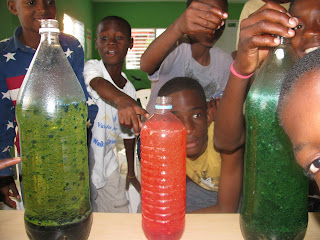
My Engineers Club has now completed half of the 12-week course we set out to do in January. This week we did what was easily my favorite, and most of the boys’ favorite, experiment to date. We went retro and made lava lamps.

I went through a phase in junior high in which my bedroom walls were covered with black light posters. Long, fluorescent beads hung from my doorway. A black light illuminated the many posters while a strobe light simultaneously flickered in the background. I also had a lava lamp. The only thing missing was Grateful Dead music and illegal substances. Those came in a later stage of life.

The Soy Ingeniero manual a fellow volunteer put together has instructions for doing a great number of scientific experiments and activities. Lava Lamps are one of them. With a 2-liter bottle, some cooking oil, water, food coloring and Alka-Seltzer tablets, you have a homemade lava lamp. Granted, these do not plug into the wall and bubble for hours, but we rarely have electricity anyway so there’s no need. The boy’s loved making the ‘lava’ bubble and I felt like a giddy 13-year old as I watched the Alka-Seltzer do its thing.

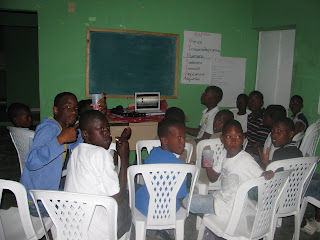
As a celebration for completing half of the Engineering course, I put on a movie night for the boys. Popcorn, soda, Valentine’s candy from the US of A (thanks Mom!) and my laptop and we were set. We watched Cloudy With a Chance of Meatballs (or Lluvia de Hamburguesas in Spanish). It is a pretty stellar animated film that incited a lot of discussion amongst the boys about science, invention, right vs. wrong and other topics. It was great to see that even while full of caffeine and sugar the boys were able to have a discussion about the movie before going home and bouncing off their parents’ walls.

Movie Night

Cupcakes!!

Sunday, February 20, 2011

P.E.

I'm kind of a P.E. teacher.

For the past 3 weeks (and the next few months) two of my superstar youth and I have been spending Wednesdays in the local school teaching Deportes para la Vida (Sports for Life).

Deportes para la Vida (DPV) is the program I received training for in December. It’s a really great program that uses sports and games to teach kids about HIV/AIDS, teenage pregnancy and other problems facing Dominican youth.

In our local school there is an hour set aside for P.E. every Wednesday and Friday. But as there is neither a P.E. teacher nor any athletic equipment or guidance whatsoever, P.E. hour is spent sitting in the shade and/or throwing rocks at one another. I don’t blame the teachers for wanting an hour of rest since students here have the ability to drive one completely insane, but that P.E. hour could be put to much better use. Enter Deportes para la Vida.

So far we have worked with 6th, 7th and 8th grade students, as those are the kids best able to grasp what HIV/AIDS is and the ones most likely to have hormones in overdrive and/or be sexually active. The kids have been really responsive to the program and we can see instant results in their knowledge about HIV/AIDS after each activity. The students might be little monsters in the classroom but, for whatever reason, they have been really attentive and engaged when given the chance to run, play, compete and learn outdoors.

So it seems that for the spring semester, I am more or less a P.E. teacher. The great thing about the DPV program is that what I am actually teaching is Sex Ed and Life Skills but the kids feel like they’re in P.E. A nice head fake to trick the kids into learning.

Wednesday, February 2, 2011

Ingenieros Dominicanos

Easily my favorite ongoing project and looking forward a true passion project of mine in the year to come is my Boys Club. A group of 15 muchachos aged 10-14 who meet weekly to work, play, learn and experiment. We have recently starting working with a fellow volunteer’s Ingenieros Dominicanos, Dominican Engineers, manual. The manual is full of interesting activities dealing with science and engineering and, so far, the boy’s are eating it up.

Last week we did an exchange with another volunteer’s boys group in a nearby batey, which was a huge success. We spent the morning doing fun and educational activities and the boys got to leave their communities and meet new muchachos.

The boys of Cachena and Experimental at the intercambio.

This week in our Engineering Club we made volcanoes, a science experiment each and every American has done but that my kids could have never fathomed before today. They might still have trouble explaining what a chemical reaction is but they relished the opportunity to make their own volcanoes and especially enjoyed making them erupt.

Showing off an erupted volcano.

Raudy getting his hands (and no doubt his school uniform) dirty.

With the leftover flour all the boys made a giant pot of bollo, a typical local dish consisting of little more than flour and water that migratory workers from the lower Antilles brought to the DR and is especially popular in the bateyes in the east.

The boys preparing bollo.

Enjoying the finished product with salami.

Wednesday, January 26, 2011

To the Batcave

Last weekend I made a quick trip into the mountains here in the eastern region to scout out a site where we would like to hold a boy’s camp. While I live in the sugar cane-covered plains, the mountains are but a bus ride away. Just ninety minutes on the guagua brought me to the beautiful mountain pueblo of Pedro Sanchez.

Pedro Sanchez from the Loma

My primary objective of the trip was to scout out the sight for the camp but I had the good fortune of tagging along on a bit of an excursion as well. The local guides group was climbing up a loma to some caves in order to clean up the trails and clean up garbage in the caves themselves. The guides group has had a Peace Corps volunteer working with them for the past few years and currently have a new volunteer as they try to attract tourists to their beautiful mountain setting.

I gladly tagged along on the trip and quickly learned how out of shape I am after a lazy holiday season and some time spent stuffing my face in the US of A. After struggling to the top of the loma, and a nice long descanso, it was time to dive into some caves.

We went into three caves in total and each subsequent cave was deeper, darker and home to more murciélagos, or bats. In America, if you are visiting caves as a tourist you will most likely be walking along carefully manicured and well-lit walkways ensuring one’s safety. In the DR there is none of the above. We climbed down rocks and boulders in the dark with only a few headlamps to lead the way. The deeper we got, the darker it got. The darker it got, the more bats there were. The more bats there were, the more guano there was to trudge through.

It was fascinating to watch the young Dominicans who had been visiting these caves since their childhood run and jump through the dark with ease without a single misstep. It is akin to the Dominican children who live near the beach that have the ability to climb a palm tree, knock down a coconut and climb back down in 8 seconds flat or the kids from my site who can cut down a stalk of sugar cane and tear it apart with their bare teeth without a second thought. Dominican kids develop some fun abilities.

The bats were at both times cool and eerie. They could be heard but not seen, without the flash of a camera that is. They would begin to stir each time we approached and the entire cave would echo with their movements. The third and final cave we visited is home to an estimated half million bats.

Entering the 3rd Cave

The ground in the cave was covered with guano that locals collect to use as fertilizer and that gringos like me inadvertently slip-n-slide through. All the Dominicans had huge rubber boots with great traction and I was roller-skating around with sad excuses for hiking shoes.

By the time we had gotten in and out of the second cave most everyone was completely covered in bat poo. The guides and locals were covered because they had a bat poo fight the way Iowans would have a snowball fight. I was covered because I slipped and fell a dozen times. So it goes. Thankfully Dominican doñas can rid of any stain and have no problems with poop.

It was a fun excursion and succeeded in physically kicking my ass. I learned that I will need to work out a bit before finally deciding to tackle Pico Duarte, the tallest mountain in the DR and all of the Caribbean, which is a volunteer rite of passage to climb during their service.

Murciélagos

Monday, January 24, 2011

Las Estrellas Orientales

The Dominican Winter Baseball League takes place each year between October and January, when the Major Leagues are in off-season. The league consists of just 6 teams. A number of Major League players and up-and-coming farm team prospects participate in the Winter League to hone their skills for the upcoming MLB season.

The team nearest to my site is the Estrellas Orientales, the Eastern Stars. As I live nearby (about 15 miles), I have deemed myself an Estrellas fan based solely on proximity. They play in San Pedro de Macoris, the mecca of Dominican baseball, where many of the great Dominican peloteros call home. This year marked the 100th anniversary of the franchise. In all of those 100 years, the Estrellas have won just 3 titles. In a league of just 6 teams.

The Estrellas are the (not so) lovable losers of the DR league. The Dominican equivalent of the Chicago Cubs. Due again to proximity and a lack of a professional team in Iowa, I regard myself as a Cubs fan. Both teams have a tendency experience long spells of losing seasons followed by teams with great promise who choke and leave their fans again disappointed. The Estrellas last title was in 1968.

One difference between the Cubs and Estrellas is that the Cubs inability to win the big game has become somewhat of an endearing trait. They have one of the country’s largest fan bases. Many, myself included, can’t help but fall for the lovable losers from the North side. Fans stay loyal and each October dutifully utter the words, “maybe next year.” The Estrellas fans don’t find the losing reputation to be quite so endearing. Many have given up entirely and taken to cheering for one of the other 5 teams that win from time to time.

This year the Estrellas made it to the league championship against the fellow team from the eastern region, the Toros of La Romana. It would have been fitting for the Estrellas to end their 42-year title drought in the 100th year of the franchise. But in true Estrellas form they lost a best-of-9 series 5 games to zero. The whole San Pedro area was abuzz only to see their team break their hearts once again in a rather embarrassing 5 games to 0 fashion. I’ve yet to hear anyone suggest “maybe next year.”

The Estrellas playing Escogido in the Capital

For more on the Eastern Stars and an interesting read check out this book, Eastern Stars, that is making the rounds amongst volunteers living in and around San Pedro.

Tuesday, January 18, 2011

Experimentation

After spending Christmas in the States, I arrived back in the DR with gifts in tow. I could not possibly have come back empty handed to a chorus of Dominicans asking, ¿Que me trajiste? (What did you bring me?). This is a phrase we volunteers hear more often than we would like. Sometimes after just a quick trip to the Capital for a meeting the local children will ask what we’ve brought back for them. A trip to the giant mall of a country that is the US would surely attract much ¿Que me trajiste?.

I obviously couldn’t bring something for everyone and focused my give-giving solely on my host family. I found many trinkets and toys in the US that would be perfect to momentarily peak the interest of local children with short attention spans while also buying things with few parts and little monetary value for when they were inevitably broken. I found crayons, kaleidoscopes, baseballs, candy, etc. And I bought some Christmas stockings for my host family in hopes of sharing some American customs and culture.

Since Dominicans do not traditionally exchange gifts on Christmas but on Three Kings or Epiphany Day (January 6th), I was able to partake in the gift giving in both the US and the DR.

My most daring purchase was something I planned to buy long before heading back Stateside. Quite often groups of American missionaries pass through my community and other area bateyes and almost literally dump gifts into the hands of Dominican children. (This creates a dependency and makes our job harder - but that rant is for another time.) The most prevalent of these gifts are knock-off Barbie dolls that little girls cling to. They spend hours on end combing Barbie’s bleach blonde locks until the have removed each and every hair on the doll’s head and lose interest. Not even batey children want a bald Barbie. The doll is always the same: white skinned with blonde hair and impossible measurements.

The gift I planned to buy each of my 3 young host nieces (ages 8, 6 and 5) was meant to be somewhat of a social experiment. I bought each of them their very own Barbie or baby doll, but each of the dolls had black skin, just like my nieces themselves. I knew that one of two things would occur.

1) The girls would love their dolls and relish the fact that the dolls ‘looked like them’ in some way.

2) The girls would be quick to label the dolls as ‘ugly’ or in some way inferior to the cheap white Barbies they have grown accustomed to.

I once watched a video in a college class dealing with this exact issue. When given a choice between white and black dolls, both white American and African American children overwhelming choose the white doll. They say it’s better, it’s prettier, it's nicer and generally preferable to the other. I was interested to know that while this may hold true in a multi-racial United States of America, would it also ring true in a developing nation of dark-skinned people?

While I had obviously hoped for scenario 1 to take place, I knew that the more likely reaction was that of scenario 2. And, lamentably, scenario 2 is exactly what unfolded. The 8 and 6 year-old nieces feigned interest in their Disney Princess Barbie for a moment before quickly moving on to the white Barbie knock-off their parents had gifted them. The 5 year-old wasted not a second to label her doll as fea (ugly) and has never touched it since. Experiment failed.

Unwanted dolls aside, my host family generally enjoyed their gifts and a successful holiday was had by all.